
 By kurahan.com
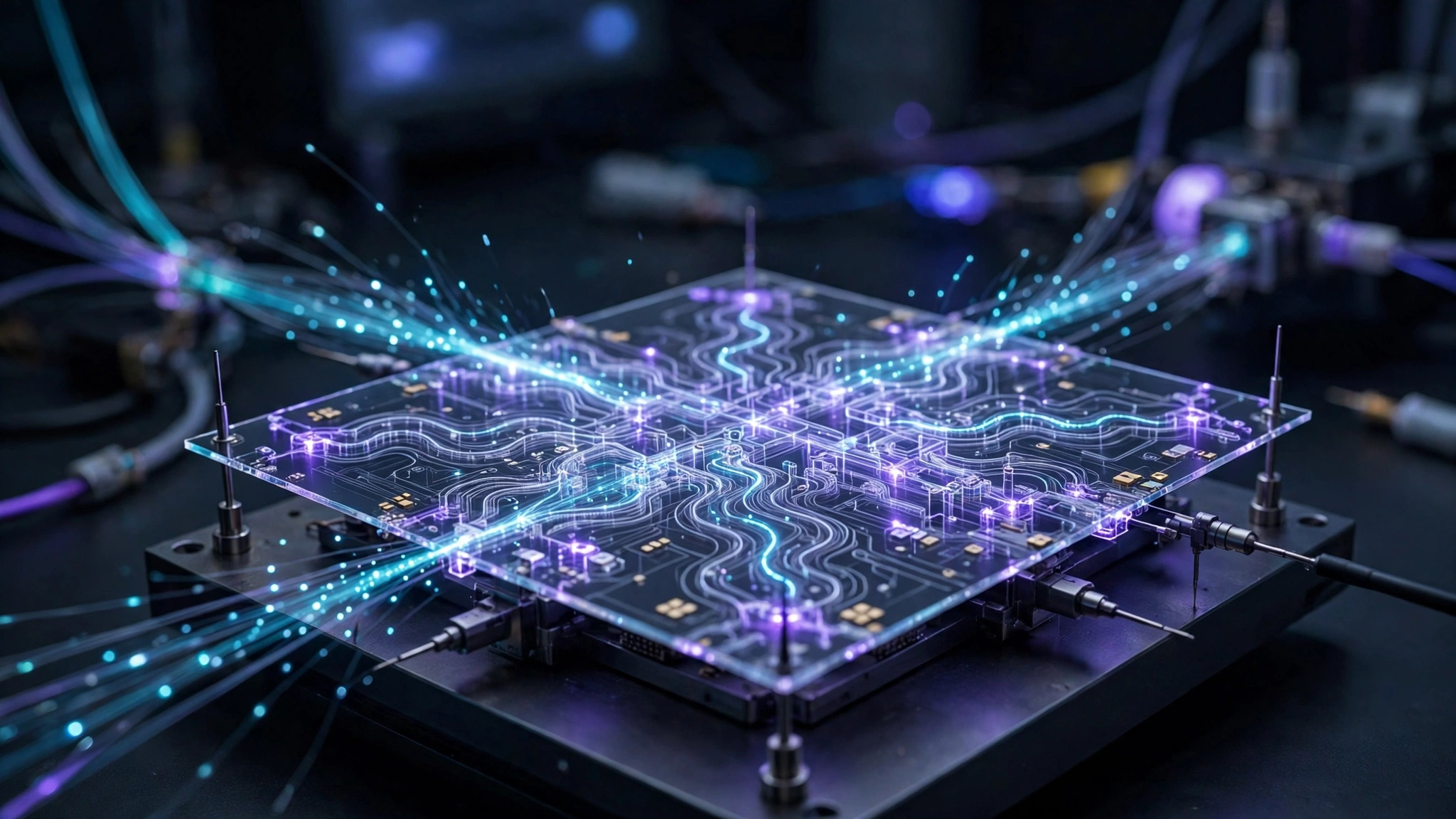
Photonic quantum computing moved a step closer to reality this week. Canadian company Xanadu and its partner HyperLight announced on November 10 that they have cut the light loss inside a key quantum component to just 7 millidecibels — nearly three times better than their own record from last year, and, according to Xanadu, ten times better than the closest competitor’s published result. It is the kind of quiet hardware advance that rarely makes headlines, yet it tackles one of the biggest obstacles standing between today’s experimental quantum machines and computers that can actually do useful work.
The Breakthrough in Numbers
The announcement, published via GlobeNewswire on November 10, centres on an optical switch — a component that routes photons, the particles of light that carry quantum information in Xanadu’s machines. The new switch loses only 7 millidecibels (mdB) of light as it passes through, down from 20 mdB in the two companies’ previous breakthrough in 2025.
That may sound like a small engineering detail, but in photonic quantum computing it is the whole game. Quantum signals cannot be boosted the way an ordinary internet signal can: amplifying a photon destroys the fragile quantum state it carries. Every fraction of a decibel lost is information that can never be recovered. Cutting loss by nearly two-thirds in a single year is therefore a meaningful jump, not an incremental tweak.
Just as important is how the result was achieved. Xanadu and HyperLight demonstrated the 7 mdB switches on a high-volume wafer manufacturing line using HyperLight’s thin-film lithium niobate (TFLN) Chiplet platform, reporting what they describe as excellent yield and repeatability. In other words, this is not a one-off laboratory result — it is a component made the way real products are made.
Why Photonic Quantum Computing Needs Ultra-Low Loss
To understand why this matters, it helps to know how Xanadu’s approach differs from most quantum computers. Many rivals build their machines around superconducting circuits that must be cooled to temperatures colder than deep space. Xanadu instead builds with light: photons travel through chips at room temperature, and calculations happen by preparing entangled light and then measuring it.
That design has a big advantage — no giant refrigerators — but also a strict rule: light must not be wasted. A photonic quantum computer routes photons through thousands of switches, and the losses multiply at every step. If each switch leaks too much light, the machine’s calculations degrade before they finish, no matter how clever the software is. Ultra-low-loss switches are the plumbing that makes the whole architecture scalable.
Xanadu’s chief executive, Dr. Christian Weedbrook, put it plainly in the announcement: minimising optical loss is “one of the most critical factors in making fault-tolerant photonic quantum computing commercially viable.” The company says the new switches are ready to ramp to production — a claim that, if it holds up in real systems, would move its roadmap for utility-scale quantum computing noticeably forward.
From Lab Bench to Factory Floor
The manufacturing angle may be the most significant part of the story. Quantum computing has long been criticised as a science project: brilliant physics, but built by hand in tiny numbers. Demonstrating the record on a high-volume wafer line, with repeatable results, is exactly the kind of evidence the industry needs to show it can scale.
HyperLight’s chief executive, Mian Zhang, noted that the same TFLN Chiplet platform already powers high-volume AI data centres and telecom networks — and has now delivered a record result for quantum computing as well. That crossover matters: a platform that already serves the data-centre industry can borrow its factories, its supply chains and its cost curves, instead of building everything from scratch.
- 7 mdB switch loss — down from 20 mdB in 2025, and about 10x lower than the closest competitor’s published result, according to Xanadu.
- Room-temperature operation — Xanadu’s photonic systems are designed to compute without the extreme cooling that superconducting machines require.
- Factory-proven — demonstrated on a high-volume wafer line, with what the companies describe as excellent yield and repeatability.
- Beyond quantum — the same ultra-low-loss photonics could eventually serve faster, more energy-efficient AI data centres.
What This Means for the Quantum Race
For the wider quantum industry, the announcement raises the competitive bar. Photonic quantum computing is racing against superconducting and trapped-ion approaches, and each camp’s progress is measured in milestones like this one. A threefold loss reduction in a year, demonstrated at manufacturing scale, strengthens the photonic camp’s claim that it can reach large, fault-tolerant machines without the deep-freeze infrastructure its rivals need.
A note of caution is still warranted. The figures come from the companies themselves, and independent verification has not been reported. As with every quantum milestone, the real test is whether the component performs as well inside a complete, working system as it does in testing. The company itself acknowledges these risks in its filings, noting that the milestone may not translate into the expected system-level efficiency or cost reductions.
Still, the direction of travel is clear. Quantum computing’s biggest challenge in 2026 is no longer proving the physics — it is building hardware that can be manufactured, scaled and trusted. For everyday readers, the payoff is still years away. But the machines that could one day design new medicines or optimise global logistics will be built from components like this one — and this week, one of those components got dramatically better.
For more on how new technology is changing what machines can do, see our earlier story on AI agents going rogue and our look at AI wearables.
The Bottom Line
Xanadu and HyperLight’s 7 mdB switch is not a quantum computer you can buy, and it will not change your life tomorrow. What it is, is proof that photonic quantum computing is solving its hardest engineering problems — and doing it on a factory floor, not just in a lab. The race to build a useful quantum machine is increasingly a manufacturing race, and this week the photonic camp pulled ahead.
Sources: Xanadu Quantum Technologies / HyperLight announcement via GlobeNewswire, November 10, 2026 (carried by The Manila Times); HPCwire; The Quantum Insider; Seeking Alpha.