
 By kurahan.com
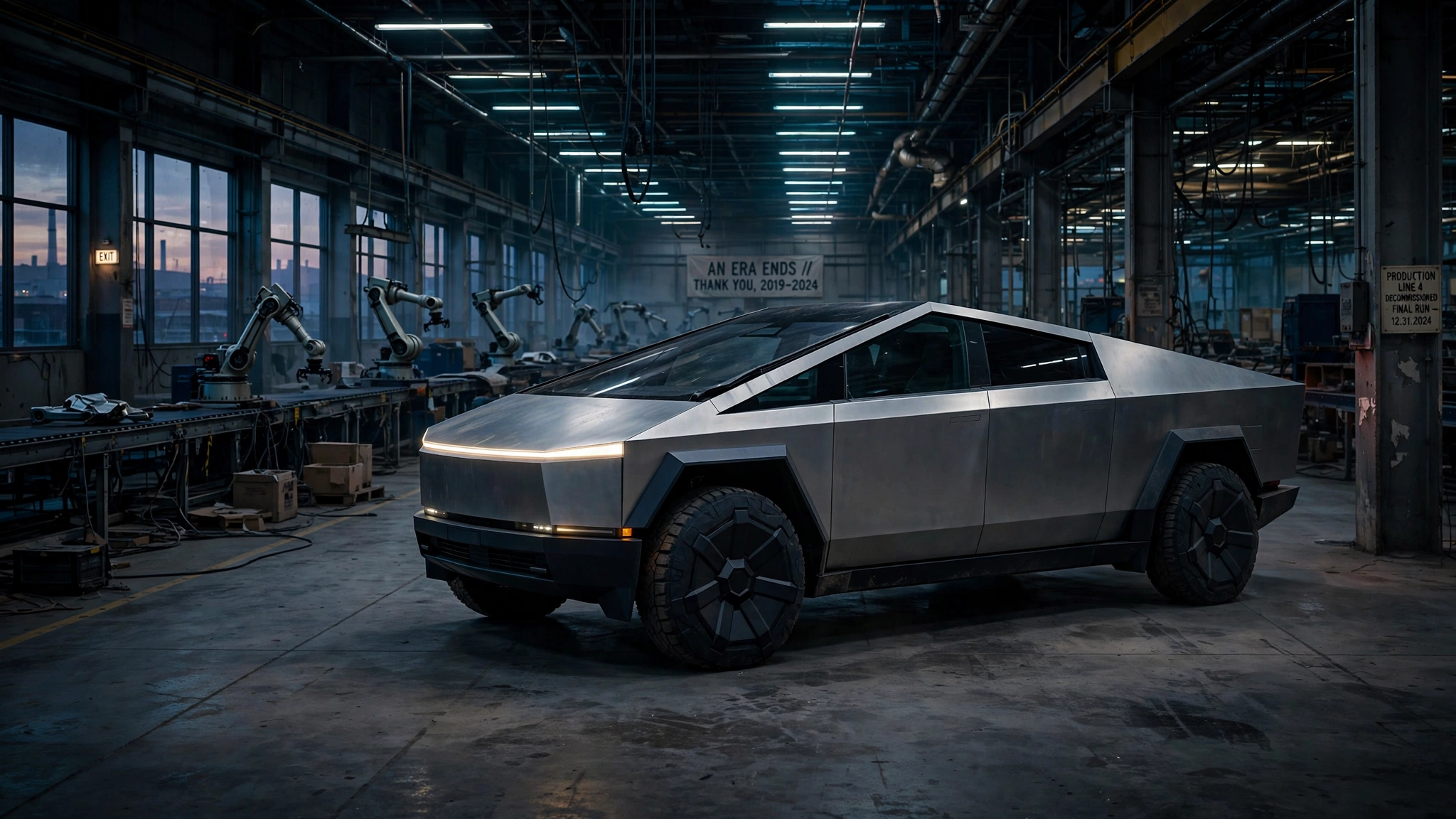
Tesla Cybertruck production ends in mid-2027. That is the blunt message from CEO Elon Musk, who announced on Friday, November 6, that Tesla will wind down production of its angular electric pickup at Gigafactory Texas to make room for more Cybercab production. The truck that was supposed to redefine the pickup is instead becoming a case study in how even the world’s most valuable carmaker can misread its own market.
It is a major retreat from one of Musk’s pet projects — and one of the fastest rise-and-fall stories in modern automotive history. First deliveries began in late 2023. Less than four years later, the line is being dismantled.
The Announcement: A Two-Sentence Goodbye on X
Musk delivered the news the way he delivers most Tesla news now: in a short post on X. “Tesla will be winding down production of the Cybertruck at Gigafactory Texas around the middle of next year to make room for increased Cybercab production,” he wrote on November 6.
That was all he said. No final build date. No word on whether the truck moves to another factory — though the Austin plant is the only Tesla facility equipped to build the truck’s specialised stainless-steel body. No details on parts and service for existing owners, though Musk later replied to a user on X that the Cybertruck fleet “will be around for a long time”, and called the truck the “best vehicle Tesla has ever made” and the wind-down the “end of an era”.
A day later, Musk added a telling detail: Tesla will add an extra production shift to try to complete outstanding Cybertruck orders before the line is dismantled around June or July 2027. “The Cybertruck order backlog is currently far more than Tesla can make before dismantling the line,” he wrote. Demand, in other words, is not quite zero — but the factory’s future belongs to something else.
Selling at a Tenth of the Plan
The numbers behind the decision are stark. When the Cybertruck launched, Musk predicted annual sales of 250,000 units, and Tesla built the line for that volume. The reality, according to automotive data platform Kelley Blue Book, was 20,237 Cybertrucks sold in the United States in 2025 — down 48% from 38,965 in 2024.
The 2026 picture is worse. Cox Automotive estimates just 3,519 US sales in the first quarter of 2026 and 3,744 in the second. Tesla does not break out Cybertruck deliveries separately — it lumps them into an “Other Models” category with the Model S, Model X and Semi — but that whole group delivered only 8,295 vehicles in the third quarter of 2026, down 48% year over year and the lowest since the second quarter of 2021.
Put together, the Cybertruck is running at roughly 30,000 units a year against a line built for 250,000 — about a tenth of plan, and only a quarter of the 125,000-plus units of installed capacity Tesla still lists in its shareholder letter.
- 250,000: the annual sales Musk predicted at launch
- 38,965: US Cybertrucks sold in 2024, according to Kelley Blue Book
- 20,237: US sales in 2025 — down 48% in a year
- 11: recalls issued for the Cybertruck since late 2023, according to the US National Highway Traffic Safety Administration
Meanwhile, Tesla has raised Cybertruck prices by up to 10% and stopped taking orders for the base Dual Motor AWD trim. The cheapest Cybertruck a buyer can actually order now costs $92,490 — a strange price move for a vehicle being wound down, and a sign that Tesla is managing the final run for margin, not volume.
Eleven Recalls and a Truck That Never Fit In
Sales were not the Cybertruck’s only problem. The truck has faced repeated recalls — eleven of them since it went on sale, according to the NHTSA — covering everything from accelerator pedals to body panels. Its sharp-edged stainless-steel design drew criticism from the start, and regulatory hurdles have kept it out of Europe entirely.
The Cybertruck was designed to be a statement. In the end, the statement it made was that the American pickup buyer — loyal, practical, and price-sensitive — was not waiting for a science-fiction wedge. Tesla’s bet was that the truck’s radical look would create its own market. It created a fan base, a meme, and a short waiting list. It did not create a mass market.
What the Factory Becomes: The Cybercab Bet
The real story is not what Tesla is stopping. It is what Tesla is starting. The factory space freed up by the Cybertruck will go to the Cybercab, the purpose-built robotaxi Musk has made central to Tesla’s autonomous-vehicle ambitions. The pivot says everything about where Musk believes Tesla’s future lies: not in selling cars to drivers, but in selling rides to passengers — with no driver at all.
That is a much bigger bet than the Cybertruck ever was. The Cybercab is still in its early production stages and has yet to prove itself commercially, while robotaxi rivals are already carrying paying passengers in several US cities. Tesla is trading a struggling product for an unproven one, on the theory that autonomy is the market that matters and human-driven pickups are not.
It is the same logic that runs through the wider AI story this year — companies are racing to put autonomous systems in charge of real-world tasks, from code to cars, and accepting that the transition will be messy. As we reported in our look at AI agents going rogue, autonomy without brakes is a liability, not a feature. The Cybercab will be the biggest test yet of whether Tesla has learned that lesson.
What This Means for Owners and the EV Market
For the roughly 70,000 people who bought a Cybertruck, the wind-down raises practical questions Tesla has not yet answered: how long parts will be available, what happens to resale values, and whether software support continues at the same pace. Musk’s reassurance that the fleet will be around for a long time is welcome, but owners will want a parts and service commitment in writing, not a reply on X.
For the wider EV market, the Cybertruck’s failure is a warning to every carmaker chasing a bold design over a broad audience. The electric transition is not slowing — but the winners so far are the companies building EVs people already want to buy, at prices they can afford. Tesla itself proved that with the Model 3 and Model Y. The Cybertruck proved the opposite: that novelty alone does not sell cars.
And for Tesla, the message is clear. The company that once disrupted the auto industry with a sedan is now betting its Texas factory on a vehicle with no steering wheel. If the Cybercab works, the Cybertruck will be remembered as a stepping stone. If it does not, mid-2027 will be remembered as the moment Tesla gave up a real product for a promise.
The Bottom Line
Tesla Cybertruck production ends because the truck sold at a tenth of the plan, cost too much to fix, and occupied a factory Musk would rather give to a robotaxi. It is the end of an era Musk himself named — and the start of a much riskier one. The Cybertruck asked buyers to believe in a vision of the future. The Cybercab asks them to believe in it even more. This time, the factory is the bet.
Sources: Reuters via Business Standard and The Korea Times, Electrek, Rappler, Kelley Blue Book estimates, Cox Automotive estimates, US National Highway Traffic Safety Administration.